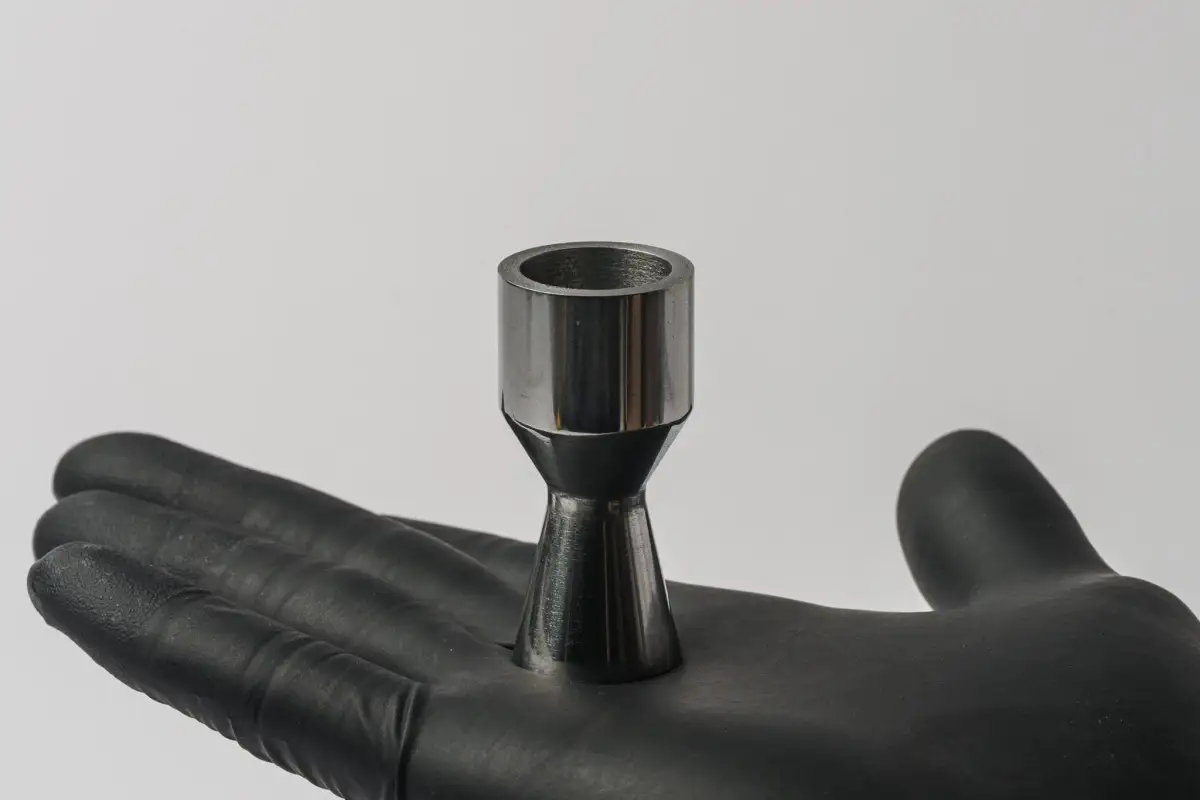
For centuries, humans have alloyed metals in much the same way as they did in the Bronze Age: heat different metals until they liquefy, then blend them in a crucible until a new material emerges.
Foundation Alloy, a young startup still in its early stages, is challenging that ancient playbook with a radically different approach—one that bypasses melting altogether and instead relies on force.
“We’re actually smashing metal powder particles together instead of melting them,” Jake Guglin, co-founder and CEO of Foundation Alloy, told TechCrunch. “We can create properties that other people can’t.”
At the moment, the company produces its custom metals in limited batches. Yet Guglin says demand is not the limiting factor. “We’re constrained by our ability to make stuff, not by the people that want to take it.”
That demand spans a surprisingly wide industrial spectrum. Foundation Alloy is currently running pilot programs with players in automotive, aerospace, semiconductor, and defense sectors, as well as manufacturers of chef’s knives and luxury watches—industries all chasing stronger, more capable materials.
“We can save them tons of money and tons of tons of waste,” Guglin said.
To scale output to several tons per week by 2027, Foundation Alloy has raised a $22 million Series A round led by Voyager Ventures, the startup exclusively told TechCrunch. The round also included Trust Ventures, Yamaha Motors, America’s Frontier Fund, Overlap Holdings, Material Impact, Engine Ventures, El Cap, and Kanematsu Corporation, which will additionally handle distribution across Japan and Southeast Asia.
The company’s roots trace back to two decades of scientific research. Tim Rupert and Chris Schuh led foundational work exploring how metals behave at the nanoscale, laying the intellectual groundwork for Foundation Alloy’s technology. Schuh is also a familiar name in the startup world, having previously co-founded Desktop Metal and Xtalic.
Where conventional alloys are produced by melting and blending different metals, Foundation Alloy uses a specialized milling system that repeatedly collides metal powders until they fuse into entirely new materials. By avoiding the melting process entirely, Guglin says the solid-state method consumes roughly an order of magnitude less energy.
At its core, alloy design aims to build a crystalline structure at the molecular level, integrating multiple metallic elements into a uniform whole. In an ideal material, that structure would be perfectly homogeneous—each crystal repeating consistently throughout the metal.
Traditional methods get close, but never quite reach perfection. Tiny imperfections and voids remain, weakening performance and making metals more brittle or more vulnerable to heat. They also struggle with combinations of metals that have vastly different melting points, leaving entire categories of potentially valuable alloys out of reach.
Foundation Alloy’s solid-state process opens the door to materials that resolve long-standing compromises. Historically, engineers have had to choose between heat resistance and mechanical strength—metals built to endure extreme temperatures tend to be brittle, while tougher materials often degrade under heat.
Now, the startup says it has begun breaking that tradeoff, producing metals that can withstand both intense heat and heavy mechanical stress. Early applications include tooling components for automakers, aerospace firms, and defense contractors, Guglin said. In defense, one early focus is drone parts, a space where supply chains were originally built around far smaller production volumes for systems like the F-35 fighter jet.
“They think about making 100 perfect parts per year,” Guglin said, “whereas drones need more like 10,000 per month.”
Guglin likens alloy creation to cooking: the same ingredients can lead to entirely different results depending on how they’re prepared. Precision in process matters as much as composition.
“The quality of the output of a dish is not just based on the ingredients, it’s how you cook it,” he said. “We have a new way to cook.”