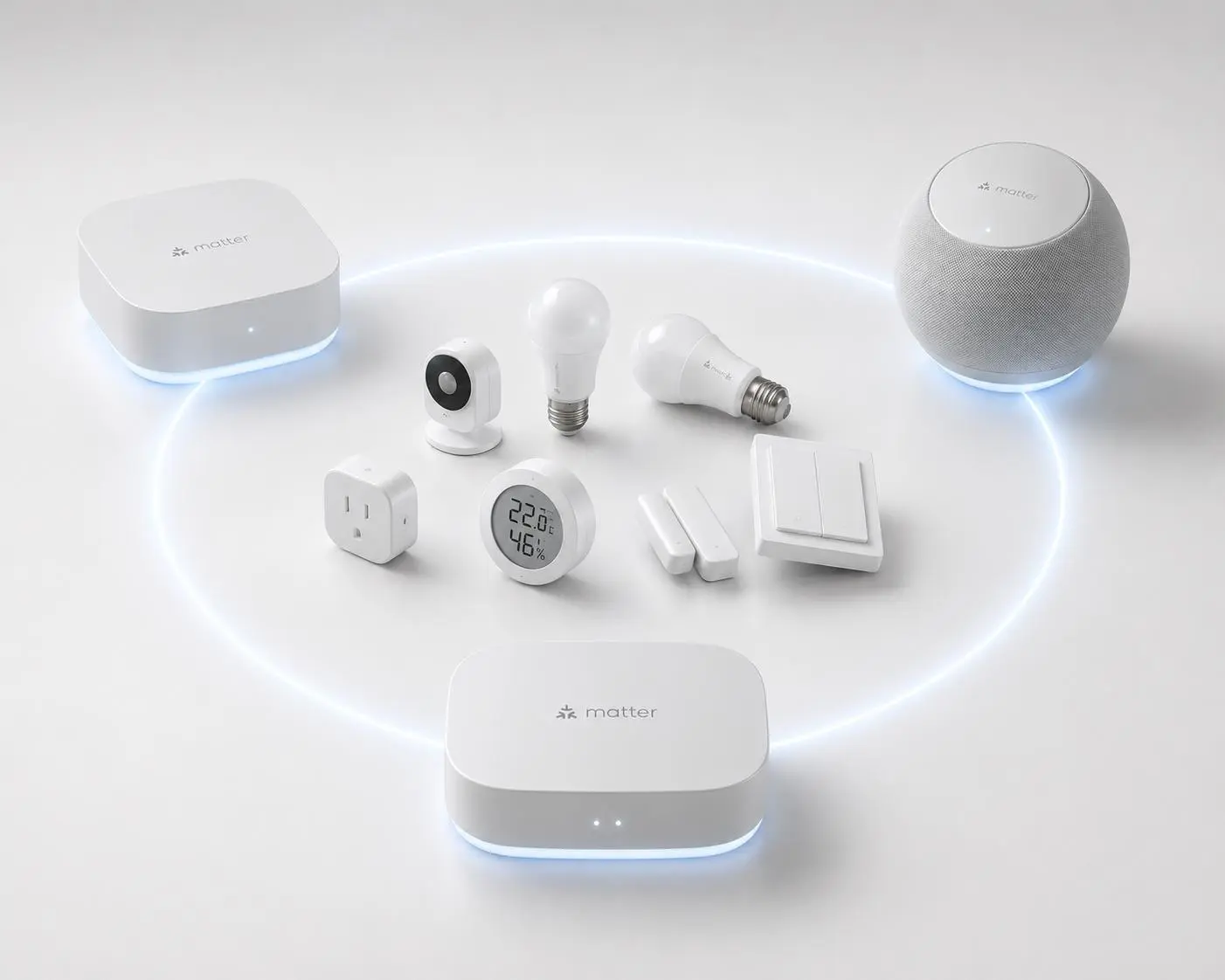
Matter smart home standard, the interoperability framework meant to unify the smart home, may finally be inching toward a feature that feels long overdue: a shared network where every major ecosystem can operate side by side.
The proposed capability—called Joint Fabric—would allow devices to live on a single Matter network that is jointly managed by multiple platforms. Once a device is added, it would no longer need to be “re-shared” between apps. Instead, it could be controlled natively across ecosystems like Apple Home, Google Home, Amazon Alexa, and others, all acting as authorized co-owners. In effect, your smart home stops behaving like fragmented accounts and starts resembling a shared system with multiple trusted signatories.
Joint Fabric arrives as part of the newly announced Matter 1.6 specification, unveiled at the Connectivity Standards Alliance’s first Unify conference in Austin, Texas. While the update does not introduce new device categories, it focuses on refining the day-to-day experience of using connected devices.
Among those refinements is full NFC setup support. Instead of scanning QR codes, users can simply tap a device to pair it—and in some cases even configure it before it’s powered on, a small but meaningful improvement for installations like ceiling lights or hardwired switches.
Another addition, called Thermostat Suggestions, standardizes how climate systems communicate across ecosystems. Rather than issuing rigid commands, platforms can now send time-based recommendations that thermostats may accept, delay, or override depending on other inputs. The aim is to prevent competing automations from colliding—so a manual adjustment on one platform isn’t immediately undone by an automation from another, and energy-saving programs or air-quality optimizations are respected across systems.
Still, Joint Fabric is the headline shift. It builds on Matter’s existing “multi-admin” approach, but tries to simplify it dramatically. Today, each ecosystem typically maintains its own separate network—or “fabric”—and shares devices between them in a layered, often awkward way. Joint Fabric would collapse that structure into a single shared foundation, where Apple, Amazon, Google, Samsung, and others all operate on equal footing.
In practical terms, that means a device would be set up once and automatically appear across all authorized platforms. Permissions could be revoked without breaking the system or forcing a full reset of devices.
The promise is a cleaner, more unified smart home—closer to what Matter smart home standard was originally envisioned to deliver. Yet the history of the standard suggests caution. Platform cooperation has often lagged behind specification design, leaving gaps between what is defined on paper and what actually ships in consumer products.
Earlier efforts, such as Fabric Sync introduced in Matter 1.4 in 2024, attempted to reduce friction by letting devices be shared across ecosystems with a single authorization. But even then, each platform retained its own separate network. Adoption has been slow, and promised rollouts have repeatedly slipped.
Joint Fabric raises the stakes further by shifting from shared access to shared control. That change subtly rebalances power away from individual platforms and toward a more user-centric model—something the industry has historically struggled to agree on.
Whether this becomes a turning point or another delayed promise depends less on the specification itself and more on how quickly the major ecosystems choose to implement it. For now, it remains an ambitious blueprint for a smarter home that finally behaves like one system instead of several competing ones.